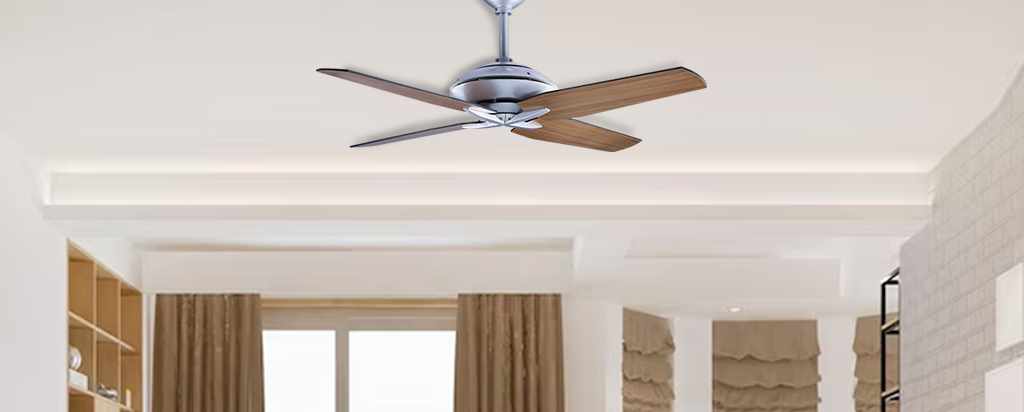
Why Most People Get Ceiling Fans Wrong
Here’s the pattern:
People pick a fan because it looks good in a showroom or online.
Then it gets installed—and either:
- it doesn’t move enough air, or
- it looks too small (or too heavy) for the space
A ceiling fan only works when three things align:
scale, airflow, and design.
Miss one, and the whole room feels off.
Quick Picks (If You Don’t Want to Overthink)
- Large living room → Airex 8 Blades
- Quiet bedroom → Bliss / Aspire
- Low ceiling → Airfoil Hugger
- Modern minimal home → Aviator 3 Blade
- Statement luxury space → Belleza / Crown Vintage
12 Ceiling Fans from The Fan Studio (Picked by Real Use Cases)
1. Airex 8 Blades (5 Feet) — For Large Living Rooms
Big rooms need air movement across the entire space—not just directly below the fan.
- Multi-blade design spreads air wider
- Works better in rooms above ~250 sq ft
- Visually fills larger ceilings
Where it fits: Villas, large halls, double-height areas
2. Airfoil — For Clean, Modern Homes
This is the kind of fan you don’t notice immediately—and that’s the point.
- Slim, aerodynamic profile
- Doesn’t interrupt the design language
Where it fits: Minimal, contemporary interiors
3. Airfoil Hugger (American Brass) — For Low Ceilings
If your ceiling is under ~9 feet, standard fans hang too low.
- Mounted close to the ceiling
- Reduces visual and physical drop
Trade-off: Slightly less air throw compared to downrod fans
4. Alaska — For Smaller Rooms
Not every room needs a dramatic fan.
- Compact and proportionate
- Does its job without dominating the space
Where it fits: Guest rooms, smaller bedrooms
5. Aspire — For Everyday Bedrooms
This sits in a comfortable middle ground.
- Balanced airflow
- Clean design without being too plain
Where it fits: Master bedrooms
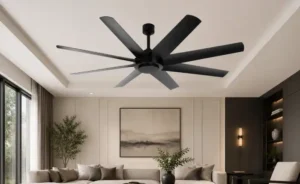
6. Bliss — For Silent Comfort
You notice noise more at night than airflow.
- Smooth, quiet operation
- No distracting motor hum
Where it fits: Bedrooms where sleep quality matters
7. Aviator 3 Blades — For Minimalist Design
Three-blade fans tend to look sharper and more modern.
- Visually lighter
- Works well in medium-sized rooms
Where it fits: Modern apartments, design-led spaces
8. Aviator Pop — For Slightly Bolder Interiors
Same base idea as Aviator, but with more presence.
- Adds character without being loud
Where it fits: Homes that aren’t strictly minimal
9. Bellerina — For Decorative Spaces
This leans more toward aesthetics.
- Softer, styled appearance
- Still functional, but design comes first
Where it fits: Styled bedrooms, boutique setups
10. Belleza — For Statement Living Rooms
Some fans are meant to be seen.
- Strong visual identity
- Works best when the room design supports it
Where it fits: Premium living spaces
11. Copter — For Practical Modern Use
Less about design drama, more about reliability.
- Straightforward performance
- Clean structure
Where it fits: Study rooms, workspaces
12. Crown Vintage — For Classic Interiors
Not every home is modern.
- Traditional detailing
- Adds a heritage feel
Where it fits: Classic or vintage-themed homes
How to Choose Without Regretting It Later
Match the Fan to Room Size
- Under ~150 sq ft → compact fans
- 150–300 sq ft → standard or 3-blade fans
- Above 300 sq ft → larger or multi-blade options
Respect Ceiling Height
- Low ceilings → hugger fans
- Higher ceilings → downrod setups for better airflow spread
Don’t Assume Design = Performance
Some designer fans look great but move less air. Always balance both.
Common Mistakes That Ruin the Setup
- Installing a small fan in a large living room
- Choosing a decorative fan and expecting strong cooling
- Ignoring ceiling height completely
- Using the same fan model across all rooms
FAQs
Which fan works best for large living rooms?
Airex 8 Blades, because it distributes air across a wider area.
Are designer fans less powerful?
Sometimes. Many prioritize aesthetics, so always check suitability for room size.
What should I choose for bedrooms?
Bliss or Aspire—both focus on consistent, quiet airflow.
Can one fan type work everywhere?
No. Each room has different airflow and design needs.
Final Thought
A ceiling fan is one of those things you don’t think about—until it feels wrong.
When it’s the right size, right height, and right style, you won’t notice it.
And that’s usually the sign you chose well.