The New Language of Luxury: Wood, Brass, Metal & Craftsmanship in Contemporary Indian Interiors
A contemporary Indian home can reveal its idea of luxury before a single piece of furniture is noticed.
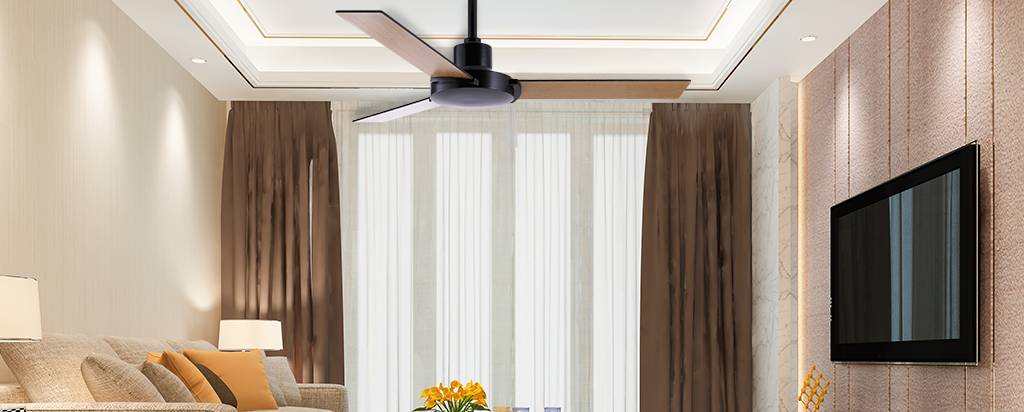
Warm wood catches the light. Stone introduces weight and permanence. Brass adds a measured glint. Textiles soften the architecture. The ceiling is carefully composed rather than simply finished.
And above it all, a ceiling fan moves quietly through the room.
The interesting part is not that the fan is expensive. It is that it does not look like an appliance that was added after the interior was complete. It feels as though the room was designed with it in mind.
That distinction points to a larger change in the way we understand luxury interior design.
What does luxury actually look like now?
Increasingly, it looks quieter. More tactile. More considered. And, importantly, more intelligent.
The new language of luxury is not built around how much a room can display. It is built around how intelligently its materials, proportions, objects and experiences work together.
That shift is particularly visible in contemporary Indian interiors, where traditional material vocabulary is meeting modern architecture, technology and a renewed appreciation for craftsmanship.
For The Fan Studio, this is not an entirely new idea. The brand has been creating custom-made, handcrafted designer fans since 1999, with its work positioned around the relationship between design, craftsmanship and functionality.
The forms may have changed.
The thinking has not.
When Luxury Stopped Needing to Shout
For decades, luxury interiors were often understood through visible abundance: ornamentation, gloss, elaborate detailing, grand scale and expensive finishes.
There is nothing inherently wrong with that vocabulary. It belongs to particular architectural traditions and continues to have its place.
But luxury interiors India are increasingly being defined through a broader vocabulary.
A room can feel extraordinarily considered without relying on obvious signals of wealth. The difference may lie in the grain of the wood, the proportion of a doorway, the way brass relates to stone, the quality of the lighting or the silence of a motor overhead.
The most expensive object in a room does not necessarily create the most luxurious room.
Context does.
This is why restraint has become such a powerful design tool. When fewer objects are competing for attention, every material and silhouette carries greater responsibility.
A ceiling fan is a good example.
Because it sits at the centre of the ceiling, it occupies one of the most visible positions in a room. Its shape, scale, finish and relationship with the ceiling can either reinforce the architecture or interrupt it.
That makes its design decision more significant than it first appears.
For a broader look at how fans are moving beyond utility, see The Fan Studio’s perspective on modern ceiling fans and contemporary home design through its existing editorial content.
Materials That Make a Space Feel Rich Without Looking Excessive
Contemporary Indian interiors are increasingly comfortable allowing materials to speak for themselves.
Wood: Warmth in a Modern Room
Wood has an immediate tactile quality.
Its grain introduces variation. Its warmth can soften stone, concrete and metal. And unlike highly polished surfaces, it does not need to announce itself to be noticed.
In a contemporary apartment, a wooden element can prevent minimalism from becoming clinical. In a villa, it can connect architecture with the landscape beyond it.
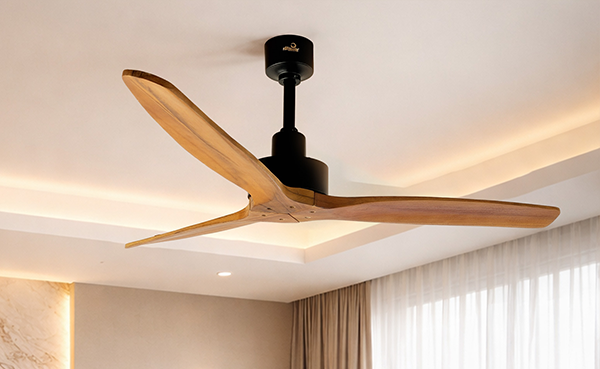
This is one reason wood interiors work so well with thoughtfully designed ceiling fans. Rather than introducing another unrelated finish at ceiling level, wooden blades can echo furniture, flooring, panelling or architectural timber elsewhere in the room.
The principle is simple: repetition creates coherence.
Brass: Warmth With a Sense of History
Brass occupies a different position.
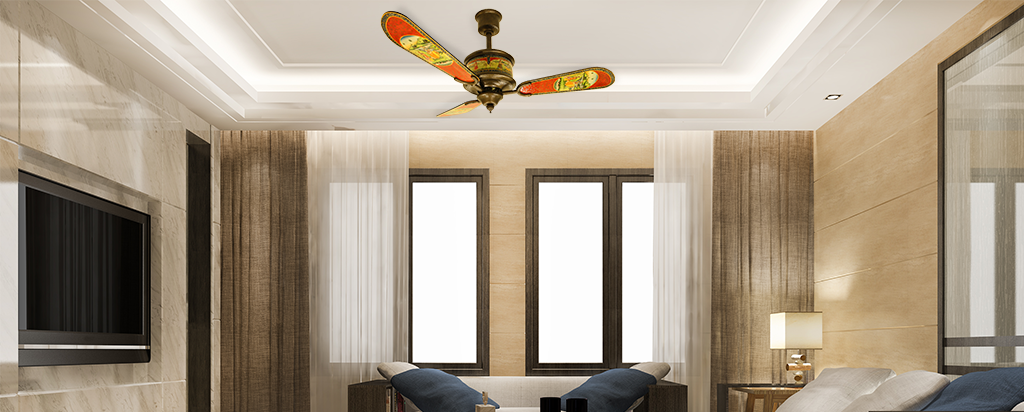
It carries associations with Indian craft, old architecture and decorative objects, but its appeal in contemporary interiors comes from its ability to work without becoming overtly traditional.
Against stone, brass introduces warmth. Against dark surfaces, it creates contrast. Alongside wood, it can make the overall palette feel deeper.
The trick is proportion.
A little brass can establish a visual rhythm. Too much can turn an interior into a catalogue of decorative finishes.
Metal: When Function Becomes Architectural
Metal brings another quality: precision.
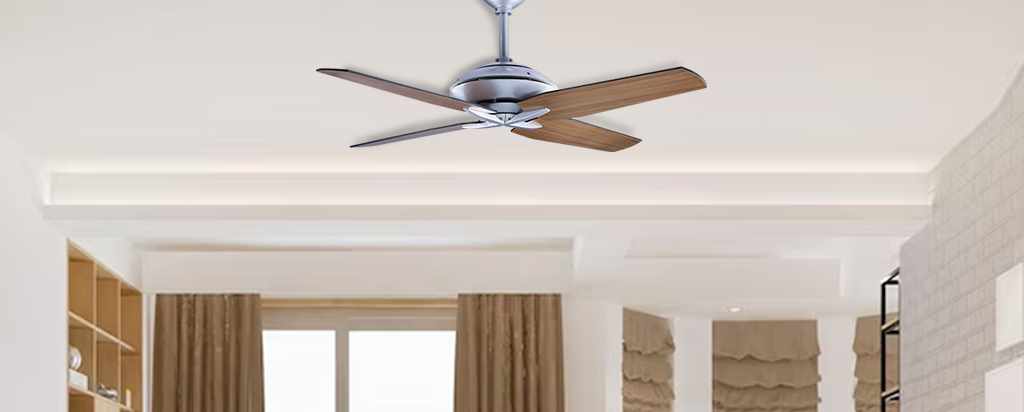
It can make an object feel engineered rather than ornamental. A metal ceiling fan with a controlled silhouette can therefore belong to an architectural interior in the same way that a carefully designed light fixture, railing or door handle does.
This relationship between material and function is central to The Fan Studio’s evolution.
Its collections include modern, classical, colonial and handcrafted designs, allowing material and form to shift according to the interior they inhabit.
For readers interested in the heritage side of this material language, The Fan Studio’s existing editorial coverage of handcrafted ceiling fans and artisanal craftsmanship provides a natural continuation of this idea.
The material vocabulary changes.
The expectation of craftsmanship remains.
The Beauty of Something Made by Hand
There is a temptation to romanticise the word handcrafted.
But craftsmanship becomes meaningful only when you consider what human involvement actually changes.
It changes how a material is finished.
It changes the attention given to small details.
It allows variation rather than eliminating it.
And it introduces the possibility that an object can possess character rather than simply consistency.
Mass production gives consistency. Craftsmanship gives character.
That distinction matters particularly in luxury home design, where individuality is increasingly valuable. A room assembled entirely from anonymous, interchangeable objects may be expensive, but it can still feel generic.
Contemporary craftsmanship does not have to look traditional.
A handcrafted object can have a highly modern silhouette. It can use contemporary engineering. It can sit inside a minimalist apartment or a modern villa without appearing nostalgic.
That is where the story becomes particularly relevant to The Fan Studio.
Its approach brings traditional making and material knowledge into a category that is usually treated as purely industrial: the ceiling fan.
The Fan Studio’s own published material describes its fans as custom-made and handcrafted in India, with a focus on combining design, craftsmanship and functionality.
The result is an object that can carry evidence of the hand without looking like a museum piece.
When Heritage Meets Modern Design
India does not need to choose between heritage and modernity.
Some of the most interesting contemporary Indian interiors are built precisely on their coexistence.
Traditional materials can sit within modern architecture. Local craft can be interpreted through contemporary forms. Brass can appear beside concrete. Wood can soften glass and steel. Hand-finished objects can coexist with automation and modern engineering.
The objective is not to recreate the past.
It is to reinterpret it.
The Fan Studio’s heritage-oriented designs provide one end of that visual spectrum: metal, brass, decorative detailing and a sense of mechanical character. Its modern collections move towards a different vocabulary—cleaner, quieter and more architectural.
This creates a useful continuity.
The language has changed. The philosophy has not.
A functional fan can still have presence.
It can still carry material identity.
And it can still contribute to the character of a room.
Technology Doesn’t Have to Look Technical
There is another dimension of luxury that is easy to overlook because it is invisible.
Performance.
A room may look extraordinary, but if the fan is noisy, poorly proportioned, difficult to operate or inadequate for the space, the experience is compromised.
Modern luxury is therefore increasingly experiential.
Quiet operation matters.
Reliable airflow matters.
Ease of use matters.
Engineering matters.
The best technology, however, does not necessarily need to announce itself.
The most successful technology often disappears into the experience it creates.
This is where the combination of craftsmanship and engineering becomes important.
The Fan Studio’s published material describes its handcrafted fans as combining traditional making with modern motor technology and performance-oriented engineering.
The interesting design proposition is that these technical considerations do not have to dictate the visual identity of the object.
A fan can look handcrafted while being engineered for contemporary expectations.
It can carry material warmth without sacrificing performance.
It can belong to a luxury interior without pretending to be something it is not.
The Ceiling Is Part of the Architecture
One of the more persistent mistakes in interior design is treating the ceiling as the final surface to be completed after everything else has been decided.
But look upward.
The ceiling contains lighting, beams, architectural lines, materials, proportions and, very often, the fan.
It is part of the composition.
This changes the question from Which fan should I buy? to something more architectural:
What should this object contribute to the ceiling?
Consider three different approaches.
Airfoil Hugger: When Proportion Becomes the Design
In a contemporary apartment or a room where ceiling height demands restraint, a low-profile silhouette can be more appropriate than a visually elaborate fixture.
This is where the Airfoil Hugger becomes an interesting design example. The model is listed within The Fan Studio’s modern collection and is specifically positioned for contemporary, low-ceiling applications in the brand’s current editorial content.
Its compact profile allows it to sit closer to the architectural plane of the ceiling, while its form can introduce visual continuity without overwhelming the room.
Airfoil Hugger — when proportion becomes part of the design.
The important point is not that it is a modern fan.
It is that its form responds to the spatial condition around it.
Airfoil: A Study in Controlled Form
Minimalism is often misunderstood as simply having fewer things.
Good architectural minimalism is more demanding. It depends on proportion, alignment, negative space and controlled visual movement.
The Airfoil belongs naturally to this conversation.
Its elongated, aerodynamic blade profile introduces movement while retaining a strong sense of order. The model is part of The Fan Studio’s current modern fan collection.
In a large contemporary living room, a silhouette like this can read less like a conventional household appliance and more like a deliberately specified piece of architectural hardware.
Airfoil — a study in controlled form.
Its value lies in what it does not demand from the room.
Paddle: Material Warmth Meets Contemporary Form
Then there is a different interpretation of modern luxury.
Not all contemporary interiors are cold, monochromatic or aggressively minimal. Many of India’s most appealing modern homes are warmer: wood, stone, natural textiles, muted colours and carefully introduced metal.
The Paddle fits naturally into this material-led vocabulary.
The model appears in The Fan Studio’s current modern collection alongside other contemporary fan designs.
Its simpler blade language can sit comfortably alongside timber, stone and brass, particularly within contemporary villas and hospitality environments.
Paddle — where natural material meets contemporary form.
Here, the fan is not competing with the room.
It is helping establish its temperature.
For more examples of how modern fans can become part of the interior rather than an afterthought, explore The Fan Studio’s modern fan collection.
The Fan as Part of the Interior, Not an Appliance
Consider how much attention goes into selecting a sofa.
Then consider the lighting.
The flooring.
The handles.
The faucets.
The artwork.
The furniture.
Yet the ceiling fan is often selected after the interior has already been designed.
That order can be reversed.
What if the fan was considered during the design process rather than at the end?
Suddenly, it becomes another material and architectural decision.
Its blades can echo the wood used in furniture.
Its motor finish can relate to the brass of the lighting.
Its silhouette can reinforce the geometry of the room.
Its scale can be considered alongside ceiling height.
Its colour can contrast against a darker ceiling or disappear into a lighter one.
The fan can become a focal point.
Or it can become almost invisible.
Both are valid forms of luxury.
The important thing is intention.
This is also the argument behind The Fan Studio’s broader approach to designer ceiling fans: the fan can be treated as part of the interior language rather than simply a cooling device.
From Heritage Hospitality to Contemporary Homes
Hospitality has long understood something residential interiors sometimes forget: people rarely remember individual specifications. They remember how a space made them feel.
That is why hotels invest so heavily in atmosphere.
The ceiling, lighting, materials, furniture, sound, temperature and movement all contribute to the experience.
The Fan Studio’s published material and portfolio positioning reference hospitality environments alongside residential and commercial applications.
For this article, the broader hospitality connection is more useful than turning a hotel reference into a sales claim.
In a hospitality environment, the ceiling is part of the guest’s visual field. A generic object can interrupt an otherwise carefully constructed interior. A considered object can reinforce it.
The same principle applies at home.
Luxury is not confined to hotels, penthouses or large villas.
It can exist in the way a modestly sized room is composed.
It can exist in the comfort of a bedroom.
It can exist in the quiet movement of air across a living room in the evening.
Comfort is not separate from luxury. It is one of its most convincing forms.
For readers exploring this relationship between comfort, airflow and hospitality, The Fan Studio’s guide to choosing ceiling fans for luxury hotels and resorts offers a natural internal reference.
What Actually Makes an Object Feel Elite?
Price is only one possible signal of value.
A truly premium object can create a different set of responses: recognition, comfort, visual satisfaction, a sense of personal identity and the feeling that the space has been resolved down to its details.
This is why context matters so much.
The same fan can feel completely different in two rooms.
Place a highly decorative fan inside an aggressively minimal interior and it may feel disconnected.
Place the same object within an interior that understands ornament, material richness and heritage and it may become the detail that completes the room.
Conversely, a sculptural modern fan may disappear beautifully into one architecture and look unnecessarily stark in another.
Luxury is therefore not simply about the object.
It is about the relationship between the object and its surroundings.
Design + material + craftsmanship + technology + comfort + context.
That is where value begins to become perceptible.
The New Language of Luxury
The vocabulary is changing.
Luxury is becoming:
Craftsmanship without nostalgia.
Technology without visual noise.
Material without excess.
Comfort without compromise.
Individuality without unnecessary ornament.
Heritage without imitation.
The Fan Studio’s evolution makes this shift visible through a category that has historically been treated as functional first and decorative second.
From handcrafted and heritage-inspired designs to contemporary forms such as Airfoil, Airfoil Hugger and Paddle, the silhouettes can evolve with changing interiors while the larger emphasis on craftsmanship and design remains.
That evolution matters because it reflects a larger change in luxury itself.
We no longer necessarily want objects that scream for attention.
We want objects that make sense.
Objects with a reason for being there.
Objects that feel good to live with.
A More Considered Kind of Luxury
The most compelling luxury interior design is not necessarily found in rooms with the most expensive materials.
It is found in rooms where those materials have been given a reason to coexist.
Wood brings warmth.
Brass brings depth.
Metal brings structure.
Craftsmanship brings character.
Technology brings comfort.
Architecture provides the context that allows all of them to work together.
And the ceiling—often ignored until the final stages of a project—can become an important part of that composition.
The Fan Studio’s published brand story traces its custom-made, handcrafted fan-making journey to 1999 and presents its work as a combination of Indian craftsmanship, design and functionality.
That is perhaps the more interesting definition of luxury today.
Not owning more.
Choosing better.
Not filling a room.
Understanding it.
And not treating comfort as something separate from beauty.
A ceiling fan may be one of the most functional objects in a room, but there is no reason for it to be the least considered.
The most memorable interiors understand that even the objects we use every day can contribute to how a space looks, feels and lives.
Luxury is no longer about owning more. It is about living better—and choosing objects that make that experience feel extraordinary.
Explore Explore The Fan Studio Modern Fans and its broader handcrafted and designer fan range for a more considered approach to the ceiling.