5 Things Architects Should Consider Before Specifying a Fan: Ceiling Fan Specification
A well-designed room is rarely the result of one decision. Architects coordinate materials, lighting, furniture, hardware, services, proportions, and circulation long before a project reaches completion.
Yet the ceiling fan is often treated differently.
It is selected late, sometimes after the ceiling plan has already been resolved and the lighting layout is fixed. The assumption is that a fan is primarily a functional object: choose an appropriate size, install it at the centre of the room, and move on.
That approach misses something important.
A ceiling fan is one of the few functional elements that occupies the visual centre of a ceiling, operates continuously, and directly influences how occupants experience a space. Its dimensions, blade geometry, mounting configuration, airflow, noise, finish, and relationship with other ceiling elements all contribute to the final result.
That is why ceiling fan specification should begin with the space rather than the product.
For architects and interior designers, specifying a ceiling fan is not simply a matter of choosing a model from a catalogue. It is an exercise in coordinating performance, spatial proportion, installation conditions, occupant comfort and architectural intent.
Here are five considerations worth resolving before a ceiling fan becomes part of the specification.
1. Start With the Space, Not the Fan
The first question in a ceiling fan specification should not be “Which fan looks right?”
It should be: What does this space require?
Begin with the basic conditions:
- Room dimensions
- Ceiling height
- Ceiling construction
- Furniture arrangement
- Occupancy
- Intended use
- Open-plan or enclosed configuration
- Relationship with adjoining spaces
A compact bedroom, a large living room, a restaurant and a double-height hotel lobby may all require ceiling fans, but they do not create the same specification problem.
Functional proportion versus visual proportion
This distinction is particularly important in architectural projects.
Functional proportion asks whether the fan is appropriately sized for the space and capable of creating the required air movement.
Visual proportion asks whether the fan occupies the ceiling at an appropriate scale.
The two are related, but they are not identical.
A fan can provide adequate air movement while appearing visually insignificant in a large room. Conversely, a visually dominant fan can overwhelm a compact interior even if its performance is technically appropriate.
Room dimensions are therefore only one part of ceiling fan selection. Ceiling height changes the mounting configuration. Furniture affects where air movement is most useful. A double-height volume may require a different approach from a conventional residential room. An open-plan space may require multiple fans and deliberate coordination rather than one oversized fixture.
ENERGY STAR guidance similarly treats fan sizing and mounting as spatial decisions, with recommended fan spans varying according to room area and mounting guidance taking floor height and wall clearance into account.
This is why the fan should enter the design conversation while the ceiling is still being planned.
The architect should know where the fan will sit, how large it will be, what it will visually occupy and how it will relate to the rest of the ceiling before the ceiling becomes fixed.
For projects where visual proportion matters as much as utility, exploring a broader range of modern ceiling fans can be useful because different blade silhouettes and mounting configurations create very different architectural readings.
2. Look Beyond Diameter: Blade Geometry Matters
Fan size is usually expressed through blade span or diameter, making it an obvious starting point.
But diameter alone does not tell an architect how a fan will perform.
A proper ceiling fan blade specification should consider the complete blade system, including:
- Blade span
- Blade pitch
- Blade width
- Blade profile
- Blade shape
- Number of blades
- Motor characteristics
- Rotational speed
- Airflow
- Control system
Blade pitch refers to the angle at which the blade is set. A higher pitch can contribute to greater air movement, but pitch by itself does not determine performance. Motor design, speed, blade material, length, shape and number of blades all influence the resulting airflow. ENERGY STAR explicitly cautions against treating blade pitch as an isolated measure of fan performance.
The same principle applies to blade count.
It is tempting to reduce the question to “three blades versus four” or “more blades versus fewer blades.” That is too simplistic for professional specification.
The U.S. Department of Energy has similarly noted that fan optimisation involves a combination of variables such as blade pitch, motor RPM and internal motor characteristics rather than treating blade count as an independent measure of efficiency.
This matters because ceiling fan blade design is where engineering and visual design meet.
A blade with a narrow, controlled silhouette can create a very different visual effect from a broader wooden blade. A curved or aerodynamic profile may influence airflow and drag. Material affects not only appearance but also weight and construction. A change in blade configuration can therefore have consequences beyond aesthetics.
The correct question is not:
How many blades should this fan have?
It is:
What combination of blade geometry, motor performance and fan size is appropriate for this space and its intended use?
That distinction prevents a common specification mistake: evaluating the fan primarily by what it looks like when stationary.
A fan is a moving component. Its design needs to work both visually and mechanically.
For architects, this makes product documentation important. Airflow figures, efficiency data and manufacturer specifications should be evaluated alongside the physical design rather than after the design decision has already been made.

3. Specify the Mounting Before the Ceiling Is Finished
Mounting is one of the easiest parts of a fan specification to overlook—and one of the most difficult to correct late in a project.
A ceiling fan does not exist independently of the ceiling.
Its installation may interact with:
- Structural support
- Electrical points
- False ceilings
- Beams
- Sloped ceilings
- Ceiling finishes
- Downrods
- Lighting fixtures
- HVAC diffusers
- Furniture layouts
Standard mounting, low-profile or hugger configurations and downrod installations each respond to different ceiling conditions.
ENERGY STAR defines a hugger ceiling fan as one where the lowest point of the blades is within 10 inches of the ceiling, specifically distinguishing it from conventional suspended ceiling fans.
For architects, the implication is straightforward: ceiling fan mounting should be coordinated at the ceiling-planning stage, not left to installation.
A downrod may be appropriate where ceiling height permits a lower operating position. A low-profile configuration may be more appropriate where vertical clearance is limited. In either case, the exact requirements of the selected fan must be confirmed through the manufacturer’s technical documentation.
Placement matters as well.
The fan should be coordinated with the ceiling composition rather than simply placed wherever an electrical point happens to exist. Consider its relationship with:
- Pendant lights
- Chandeliers
- Recessed lighting
- Beams
- Coffers
- Skylights
- HVAC outlets
- Architectural ceiling features
A visually strong ceiling can be undermined when a fan is introduced without regard to the composition.
This is also where ceiling fan placement becomes a spatial-planning issue. In a dining area, for example, the fan may need to relate to the table rather than the geometric centre of the room. In a living room, furniture arrangement may determine the most useful position. In hospitality projects, repeated fan locations may need to align with a broader ceiling grid.
The Fan Studio’s current product information also shows why mounting needs to be considered early: several models offer customised rod lengths, ceiling caps and hanging clamps. The Hugger O2 is one example of a low-profile configuration designed around ceiling integration.
The exact mounting solution, however, should always be verified against the selected model and project conditions.
4. Specify for Comfort, Not Just Airflow
A fan can have a strong airflow specification and still be the wrong fan for a particular room.
Why?
Because airflow is a performance characteristic. Comfort is the experience created by that performance within a space.
Occupants experience the result of the complete system: air movement, speed, noise, vibration, room conditions, furniture placement and duration of use.
A bedroom, for example, has different expectations from a restaurant or hotel lobby.
In a bedroom, operating noise and smoothness can become particularly noticeable because the background environment is quieter. In a restaurant, the fan needs to support comfort without becoming visually or acoustically distracting. In a workspace, air movement may need to complement rather than interfere with the HVAC strategy.
This is why ceiling fan airflow should be evaluated alongside:
- Operating noise
- Vibration
- Speed control
- Motor characteristics
- Air distribution
- Occupant position
- Room conditions
Technical airflow ratings are useful because they provide measurable performance data. But they should not be interpreted in isolation.
ENERGY STAR’s ceiling-fan criteria, for example, evaluate both airflow and efficiency, expressed in cubic feet per minute per watt. Its technical guidance also points to motor engineering, bearings, balance and internal components as factors that influence stable and quiet operation.
For a professional ceiling fan specification, the better question is therefore not simply:
How much air does this fan move?
It is:
How will this fan’s performance be experienced in this particular space?
That question changes the specification.
It encourages designers to consider low-speed operation, control requirements, potential vibration, acoustic expectations and how air movement interacts with the occupancy pattern.
For hospitality and commercial environments, this becomes even more significant. A fan is part of the guest or user experience. It needs to perform consistently without becoming an unwanted focal point.
5. Make the Fan Belong to the Architecture
Once the technical requirements have been established, the final question is visual:
Does the fan belong here?
A ceiling fan is unusually exposed. Unlike a piece of furniture that can be moved or a wall finish that occupies a vertical plane, the fan sits within the ceiling composition and remains visible from multiple points in the room.
Its:
- Blade silhouette
- Finish
- Material
- Colour
- Hub
- Mounting
- Proportion
can therefore influence the architectural language of the interior.
This is where architectural ceiling fans become different from simply functional ceiling fans.
Wood
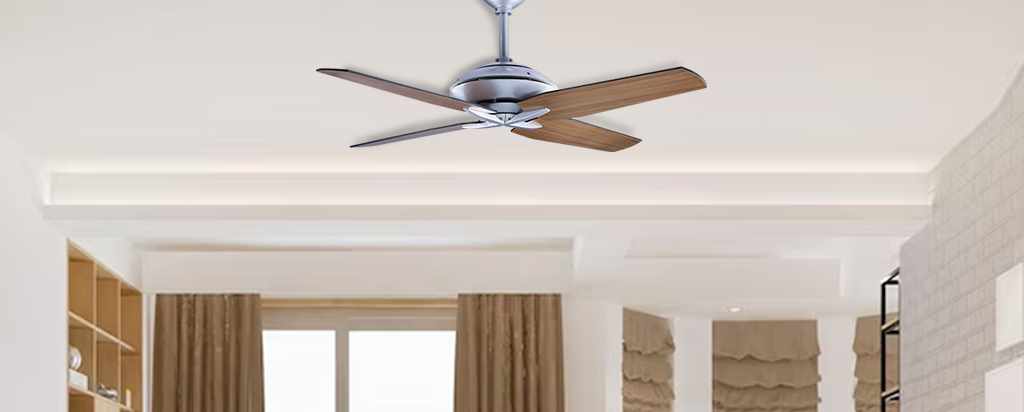
Wooden blades can reinforce interiors built around natural materials, timber, stone and warm neutral palettes. They can work particularly well in villas, contemporary Indian residences, resorts and spaces where material texture is part of the design vocabulary.
Brass
Brass can connect with warm lighting, timber, stone and hospitality interiors where metal detailing is already present. The important consideration is not whether brass is “luxurious,” but whether its tone and visual weight belong to the project’s material palette.
Matte black
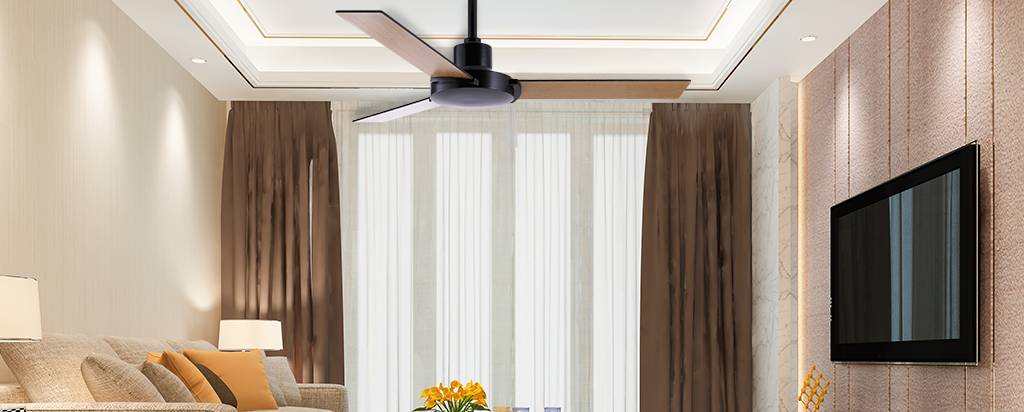
Matte black can support minimal, contemporary or industrial-inspired interiors, particularly where other architectural elements use dark metal detailing.
Handcrafted or artisan finishes
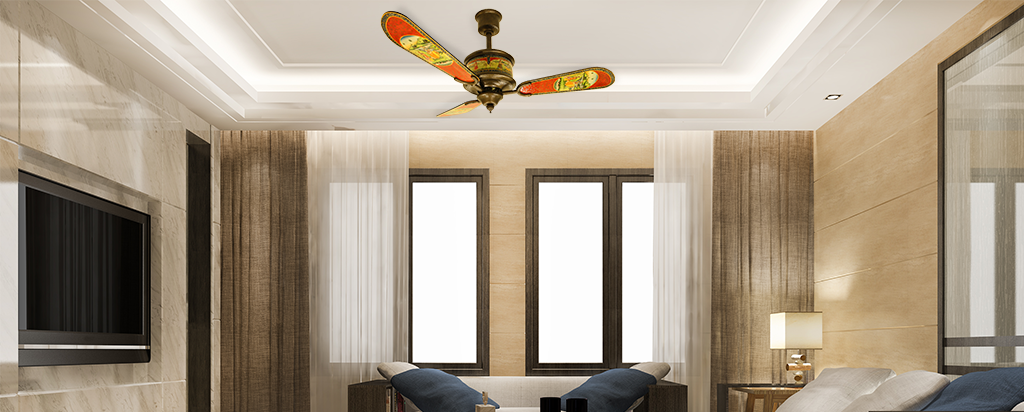
In projects where individuality and material character are important, handcrafted details can make the fan feel less like a standard mechanical component and more like a considered architectural object.
The principle is simple:
The correct finish is the one that supports the architectural language of the project.
This is also why designer ceiling fans should not be evaluated purely as decorative objects. Their design needs to remain compatible with the technical requirements established earlier.
The Fan Studio’s Modern Fans collection demonstrates this range through different blade forms, materials and finishes, including models such as Airfoil and Airfoil Hugger.
The point is not that one design is universally better than another. It is that different architectural conditions call for different visual and functional responses.
When Standard Specifications Are Not Enough
There are projects where a standard product specification solves the problem.
There are also projects where it does not.
A bespoke approach becomes relevant when the architecture includes unusual ceiling conditions, highly specific material palettes, demanding proportions or a strong requirement for visual consistency across multiple spaces.
This is where custom ceiling fans can become a specification tool rather than simply a decorative upgrade.
Customisation may involve elements such as:
- Finish
- Colour
- Blade material
- Rod length
- Ceiling cap
- Hanging hardware
- Decorative detailing
- Project-specific dimensions
The Fan Studio’s current product information confirms customisation options on selected models, including customised rod lengths, ceiling caps and hanging clamps. Its broader custom-fan material also describes made-to-order approaches for architectural and interior requirements.
But architects should distinguish between aesthetic customisation and engineering customisation.
Changing a finish is primarily a visual decision.
Changing blade geometry, dimensions or motor requirements can affect balance, structural loads, rotational behaviour and performance. Those changes should therefore be assessed technically rather than treated as simple aesthetic modifications.
Customisation is most useful when it solves a real specification problem.
Why Specification Matters to The Fan Studio
The Fan Studio’s approach is relevant to this discussion because its product philosophy sits between craftsmanship, engineering, material selection and design.
The current collection includes modern models alongside handcrafted and custom-oriented designs, while individual product pages provide information on blade materials, sweep sizes, motor types, finishes and customisation options.
Consider the Hugger O2 as an example of how mounting and visual integration can become part of the product decision. Its low-profile format and available customisation make it relevant to projects where ceiling height and visual drop need to be considered together.
The Aviator 3 Blade illustrates a different direction: a three-blade configuration with solid beech wood blades and a more expressive material presence. Its current product specification also lists a default 50-inch sweep and customisable sweep range, providing an example of why product-level technical information matters during specification.
The lesson is not to select a particular model because it looks appropriate in isolation.
It is to evaluate the model against the architecture.
That is the difference between product selection and ceiling fan specification.
A Practical Ceiling Fan Specification Checklist
Before finalising a fan, an architect or designer should be able to answer the following.
SPACE
- What are the room dimensions?
- What is the finished ceiling height?
- What type of ceiling construction is involved?
- What is the expected occupancy?
- Is the space open-plan, enclosed or double-height?
- Where are the primary occupied zones and furniture groups?
PERFORMANCE
- What level of air movement is required?
- What fan sweep is appropriate?
- What blade configuration is being specified?
- What motor/system performance is documented?
- Are noise and vibration important for the space?
- Are the relevant airflow and efficiency figures verified?
INSTALLATION
- What mounting configuration is required?
- Is structural support adequate?
- Are electrical requirements coordinated?
- Is a downrod required?
- Does the fan conflict with beams, lights or HVAC?
- Have the manufacturer’s installation requirements been reviewed?
DESIGN
- Does the blade silhouette suit the architecture?
- Does the finish belong to the material palette?
- Does the fan have the right visual scale?
- Does it coordinate with lighting?
- Does it relate appropriately to furniture and ceiling features?
- Is customisation necessary?
PROJECT
- Is this a residential, hospitality or commercial application?
- What are the maintenance expectations?
- Are there environmental considerations such as humidity or dust?
- Has the manufacturer’s technical documentation been reviewed?
- Are warranty and service requirements understood?
A useful specification sequence is:
Space → Performance → Mounting → Comfort → Design → Product
Not:
Product → Space
That change in sequence alone can prevent many downstream design compromises.
Conclusion
A ceiling fan should not be selected after the architecture is finished.
It should be considered while the architecture is being resolved.
The right ceiling fan specification brings together five decisions: the scale of the space, the geometry and performance of the blades, the mounting conditions, the experience of airflow and noise, and the visual language of the interior.
The fan therefore becomes part of the architectural coordination rather than an object added to an already completed ceiling.
For architects and designers, that is the real value of specification: not simply finding a fan that works, but finding one whose performance, installation conditions, proportion and design intent work together.
For projects that require something beyond a standard catalogue solution, The Fan Studio’s range of designer ceiling fans and customisable configurations provides another route to consider—particularly when material, proportion and ceiling integration are central to the design.
The right ceiling fan is not simply the one that fits the room.
It is the one that satisfies the room’s performance requirements, installation conditions and architectural intent at the same time.