Why Fan Blade Design Matters: Airflow, Proportion and the Architecture of Movement
A ceiling fan is easy to understand until you start looking closely at its blades.
They appear simple: a few surfaces attached to a rotating motor.
But switch the fan on and the simplicity disappears.
The blades accelerate through the air. Pressure changes develop around their surfaces. Air begins to move. The room acquires a different sensation without its temperature necessarily changing.
And then there is the visual transformation.
A stationary blade is a recognisable shape.
A rotating blade becomes rhythm.
Its edges blur. Its silhouette changes. Light moves across it. Shadows shift. The object becomes part of the room’s visual activity.
This is why fan blade design deserves more attention than it usually receives.
A blade is not simply the part of a ceiling fan that happens to move. It is an engineered component whose geometry works with the motor and the rest of the fan system to produce air movement. At the same time, its dimensions and shape determine how the fan looks when it is installed in a room.
That gives the blade two distinct roles.
It has to work. And it has to belong.
The interesting design problem begins where those two requirements meet.
What Happens When a Fan Blade Rotates?
Imagine holding your hand outside the window of a moving car.
Change the angle of your hand and the force you feel changes.
A fan blade operates on a far more complex aerodynamic principle, but the analogy illustrates one fundamental idea:
Geometry changes interaction with air.
A rotating blade continuously moves through the surrounding air. Its pitch and shape influence that interaction, while its speed determines how quickly the blade passes through the air.
The result is air movement that can be felt below and around the fan.
This is why the phrase ceiling fan airflow is more complicated than it sounds.
Airflow is not simply something the motor produces and the blade receives.
The blade helps create it.
The motor provides the rotational input.
The geometry determines how that input interacts with the air.
The room determines what happens next.
That final point matters.
The same fan can produce a different perceived experience depending on where it is installed, the height of the ceiling, the surrounding geometry and where people are actually located.
The fan is therefore only one part of the air-movement system.
Blade Pitch: The Angle That Changes the Interaction
Among the technical terms associated with fan blades, pitch is one of the most useful to understand.
Ceiling fan blade pitch refers to the angle of the blade.
Changing that angle changes how the blade interacts with air as it rotates.
A higher pitch can generally contribute to greater air movement, but this does not mean that increasing pitch indefinitely produces a better fan.
ENERGY STAR specifically cautions that pitch alone does not determine air movement and that higher pitch is not automatically better. Motor characteristics, speed, blade design and other variables must be considered together.
That nuance is important.
A blade with a particular pitch needs a motor capable of driving it appropriately.
Its geometry matters.
Its dimensions matter.
Its operating speed matters.
So there is no universally correct blade pitch that can be applied to every ceiling fan.
The right question is not:
“What is the highest pitch?”
It is:
“What blade geometry works effectively with this motor and this fan system?”
That is a much more useful engineering question.
Span: Why Bigger Is Not Simply Bigger
Another specification people notice immediately is fan diameter.
Technically, blade span refers to the largest swept circle created by the blade assembly. ENERGY STAR uses this measurement as the standard definition of ceiling-fan diameter.
But diameter has two consequences.
The first is functional.
The second is spatial.
A larger fan sweeps a larger area.
A smaller fan occupies less physical and visual space.
ENERGY STAR’s guidance connects fan size with room dimensions and also considers mounting height when selecting and positioning a fan.
This leads to an important distinction.
Engineering Scale
How the fan’s dimensions contribute to the movement and distribution of air.
Visual Scale
How large the fan appears in relation to the ceiling, furniture and room.
These are not necessarily the same thing.
A fan can be appropriately sized from an airflow perspective but visually overpower a compact room.
Another fan can look beautifully proportioned but be unsuitable for a large space.
This is why ceiling fan blade size should be considered as part of a larger specification rather than as a standalone aesthetic choice.
Room dimensions, ceiling height, mounting position and intended occupancy all matter.
The fan has to fit the space physically before it can fit it visually.
The Geometry Beyond Pitch
Pitch gets most of the attention, but a blade is a three-dimensional form.
Its geometry includes far more than its angle.
Consider:
- Length
- Width
- Taper
- Chord
- Curvature
- Sweep
- Leading edge
- Trailing edge
- Tip shape
- Thickness
- Surface profile
These characteristics influence the blade’s aerodynamic behaviour and its visual identity.
That is where ceiling fan blade design becomes particularly interesting.
A blade can be long and narrow.
It can be broad and substantial.
It can taper towards its tip.
It can have a pronounced sweep.
It can appear almost like a straight architectural line.
Or it can carry a more organic silhouette.
These differences are not simply decorative decisions.
They are decisions about the shape of a rotating surface.
And because the surface rotates, the geometry is experienced twice:
as a static form and as movement.
The Blade Tip Is Part of the Design
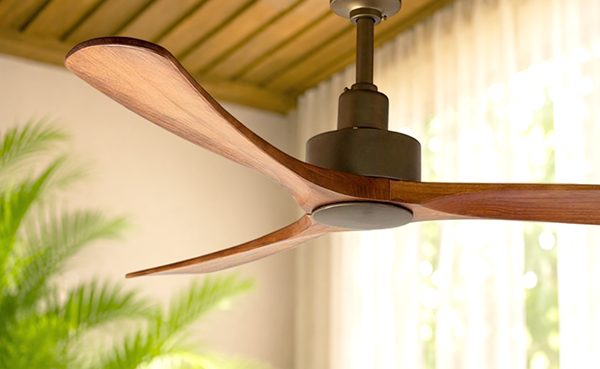
The outer edge of the blade deserves particular attention.
As the blade rotates, its tip travels through the largest circular path of the assembly.
That makes the tip important both mechanically and visually.
A blade with a strongly tapered tip creates a different silhouette from one that maintains a consistent width.
A sharply defined tip creates a different visual rhythm from a rounded one.
A sweeping blade produces a different sense of motion from a straight blade.
This is where product design starts to overlap with engineering.
The outer edge is not merely the end of the blade.
It helps define the identity of the entire fan.
And when the fan rotates, that identity becomes kinetic.
The shape is no longer seen as one object.
It is perceived as a repeated circular movement.
Airflow Is Not the Same as Comfort
There is another distinction worth making.
Airflow is a technical output. Comfort is an experience.
A fan can move air effectively, but the way that air reaches occupants matters.
Air movement can influence thermal comfort by increasing the sensation of cooling at the skin. ASHRAE’s thermal-comfort guidance recognises that air movement can be beneficial under conditions where people are warmer than neutral. It also considers air velocity and turbulence in relation to draft sensation and comfort.
That means a good fan specification cannot stop at:
“How much air does it move?”
It should also consider:
Where does the air move?
How consistently does it move?
Who is experiencing it?
At what speed?
This brings the room back into the equation.
Furniture can interrupt movement.
Ceiling height changes the relationship between the fan and occupants.
Fan placement changes the area affected.
Air-conditioning changes the thermal environment.
Occupancy changes where comfort is required.
The fan therefore does not create comfort in isolation.
It contributes to a larger environmental system.
The Motor and Blade Have to Work Together
The blade gets most of the visual attention.
The motor does much of the invisible work.
A motor has to rotate the blade assembly at the required speed and under the intended operating conditions.
That is why blade geometry cannot be specified independently of motor characteristics.
ENERGY STAR’s performance guidance explicitly identifies motor design and speed alongside blade pitch, design, material, number and length as contributing factors.
This relationship also explains why changing blades on an existing fan is not necessarily a harmless visual modification.
ENERGY STAR notes that quality fan blades are balanced and matched to their fan systems and that changing blade styles can affect performance.
The lesson is straightforward:
A fan is an engineered assembly, not a collection of interchangeable decorative parts.
That becomes even more important when discussing custom ceiling fans.
Balance: The Engineering You Notice When It Goes Wrong
A rotating object magnifies imbalance.
A tiny inconsistency that is barely visible when a blade is stationary can become noticeable once the entire assembly is rotating.
That is why balance matters.
A fan needs to operate without excessive vibration.
The blades need to work as a matched assembly.
The mounting needs to support the system properly.
The motor needs to remain stable during operation.
This is one of the less visible aspects of ceiling fan technology.
You do not normally admire a balanced fan.
You simply experience its smooth operation.
That is often what good engineering looks like.
The success is measured by what does not happen:
No distracting vibration.
No unnecessary mechanical noise.
No instability.
No visual wobble.
In a well-designed product, engineering disappears into normal use.
Noise Is Also a Design Variable
Noise is often treated as a motor issue.
But the complete fan system contributes to what the user hears.
Motor characteristics matter.
Balance matters.
Mounting matters.
Blade interaction with air matters.
The operating speed matters.
This is particularly important in spaces where sound is part of the experience: bedrooms, libraries, hospitality rooms, workspaces and quiet living areas.
A visually sophisticated modern ceiling fan that creates distracting noise can undermine the very environment it was selected to support.
This is why product design cannot stop at the silhouette.
The fan has to perform quietly enough for its intended context.
The quieter the system becomes, the more easily the fan can disappear into the background.
And that is often the objective.
Not silence for its own sake.
But allowing the room to remain the dominant experience.
Airfoil, Airfoil Hugger and Paddle: Three Ways of Thinking About Blade Form
Once the engineering principles are understood, different fan silhouettes become easier to read.
The important question is not which one looks “better.”
It is:
What design language does the blade create?
Airfoil: The Controlled Line
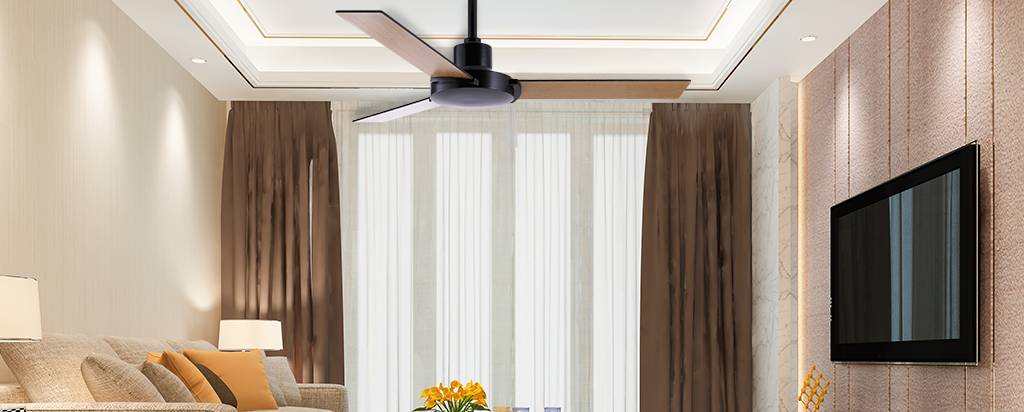
The Airfoil can be read through its elongated, controlled visual profile.
Its form creates a strong directional quality.
Rather than making the fan visually heavy, the blade language can emphasise length and movement.
This makes it a useful case study in how a blade can become an architectural line.
Airfoil — when the blade becomes a line in motion.
Explore the Airfoil and The Fan Studio’s modern fan range for the broader collection context.
Airfoil Hugger: Changing the Vertical Relationship
The Airfoil Hugger addresses a different spatial condition.
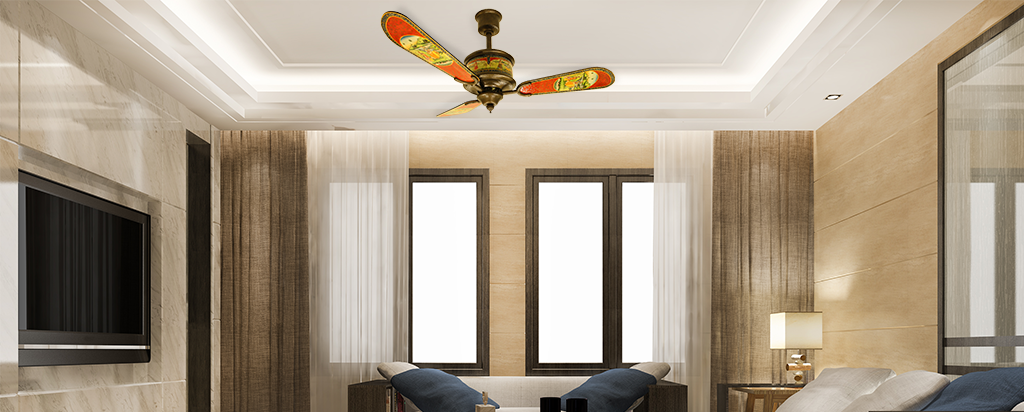
A hugger fan is designed to sit closer to the ceiling. ENERGY STAR defines a hugger fan as one where the lowest point of the fan blades is 10 inches or less from the ceiling.
The Fan Studio’s current Hugger O2 listing, for example, identifies a 48-inch default sweep and offers a customisable sweep range, illustrating how the category can be configured around different spatial requirements.
The important design point is not the number.
It is the relationship.
The closer the fan sits to the ceiling, the more important the visual and physical relationship between blade, ceiling and room becomes.
Airfoil Hugger — when the distance between blade and ceiling becomes part of the design.
Paddle: Making the Blade More Visible
The Paddle represents another approach to blade expression.
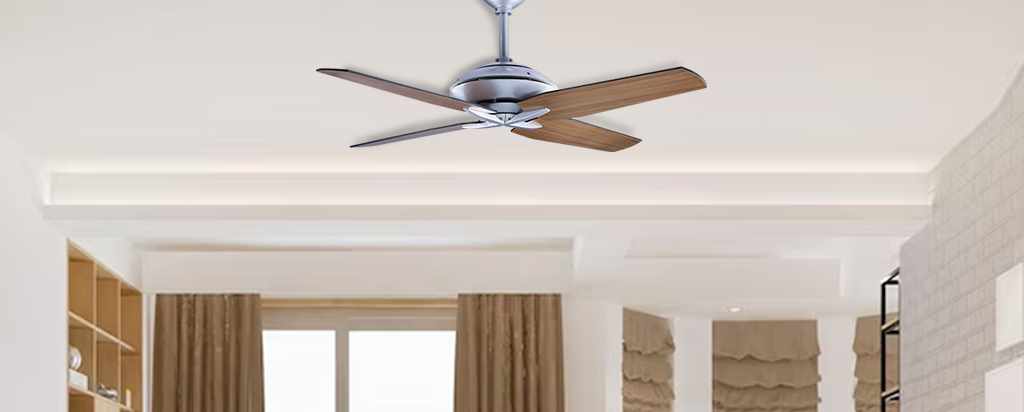
Rather than relying primarily on a streamlined visual line, a broader blade language can make the fan more visibly present within the room.
That makes it useful for examining how blade proportion affects visual weight.
The blade becomes something the eye can read as a larger surface rather than simply a narrow line.
Paddle — when the blade becomes part of the visual mass of the room.
These three examples demonstrate something important:
The geometry of a blade does not merely determine how the fan looks.
It determines how movement is perceived.
Customisation Is an Engineering Question Too
Customisation sounds like a design-service word.
But with a rotating product, it can quickly become an engineering question.
Changing a finish is one thing.
Changing blade dimensions is another.
Changing the blade geometry is another again.
The Fan Studio’s published material documents customisation options across fan components, including custom blade sizes and finishes, with its brochure also listing customisable sweep ranges for certain models.
This creates an important distinction.
Cosmetic Customisation
- Finish
- Colour
- Surface treatment
- Material appearance
Functional Customisation
- Blade dimensions
- Sweep
- Geometry
- Mounting
- Motor requirements
The second category needs technical consideration.
A blade is part of a rotating system.
Change its dimensions and you may change its aerodynamic behaviour.
Change its mass distribution and you may affect balance.
Change its geometry and you may alter the interaction between the blade and air.
That is why custom fan design should never be understood as simply making a standard fan look different.
The strongest customisation begins with a requirement.
Then engineering determines what is possible.
Then design determines how that solution should look.
Three Questions Before Specifying Any Fan
A designer can reduce much of this complexity to three questions.
What Should It Do?
Performance.
How should air move through the space?
How Should It Fit?
Proportion.
Does the fan’s size and mounting suit the room?
How Should It Move?
Character.
What will the blade geometry make the fan look like when it rotates?
These questions create a more complete specification.
They also prevent one of the most common mistakes in product selection:
Choosing a fan based on a single attribute.
The largest fan is not automatically the best.
The highest pitch is not automatically the best.
The greatest blade count is not automatically the best.
The most visually striking blade is not automatically the best.
A fan is successful when the system works as a whole.
The Architecture of Movement
This brings us back to the unusual nature of the ceiling fan.
Most architectural objects are static.
A wall is static.
A table is static.
A light fixture is static.
A ceiling fan is not.
Its design has to work in two states.
At rest, it is form.
In operation, it is movement.
That makes the blade a rare kind of architectural component.
Its geometry determines the shape of the object.
Its rotation creates a visual rhythm.
Its movement changes the air.
Its material changes the way light is perceived.
Its scale affects the ceiling.
And its performance changes the occupant’s experience.
This is the architecture of movement.
It is not architecture in the conventional sense of walls, columns and floors.
It is the design of an object whose physical operation becomes part of the atmosphere of a space.
That is why blade design deserves to be examined as both engineering and visual language.
What Good Fan Blade Design Actually Solves
The best blade design does not solve only one problem.
It solves several simultaneously.
It has to interact effectively with air.
It has to work with the motor.
It has to maintain balance.
It has to operate within its intended speed range.
It has to suit the fan’s overall dimensions.
It has to create an appropriate level of air movement.
It has to operate comfortably in its intended environment.
And it has to make sense visually.
That is a demanding design brief for something that can look deceptively simple.
It is also why the blade should not be treated as an afterthought.
The blade is where the fan’s engineering becomes visible.
It is where performance becomes movement.
And it is where movement becomes design.
Where The Fan Studio Enters the Picture
The relevance of The Fan Studio is clearer after understanding the problem.
The question is not simply whether a fan can move air.
The question is how engineering, blade geometry, material, customisation and visual design can be resolved in the same object.
The Fan Studio positions itself around custom-made and handcrafted fan design, with its published material tracing its custom-made designer fan journey to 1999 and describing a combination of craftsmanship, design and functionality.
Its contemporary designs provide useful examples of different approaches to blade form.
Airfoil demonstrates how a controlled blade profile can create a strong directional silhouette.
Airfoil Hugger demonstrates how blade-to-ceiling proximity changes the design problem.
Paddle demonstrates how a broader blade language can increase the visual presence of the moving surface.
The important point is not that one is universally better.
Each represents a different response to the relationship between blade, motor, ceiling and space.
That is the more useful way to look at a designer ceiling fan.
Not as decoration added to engineering.
But as engineering that has been given a design language.